Saturday, November 1, 2014

A Greenback Dollar

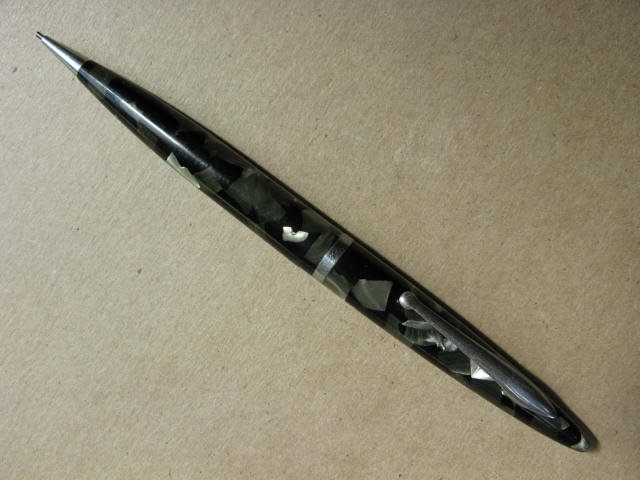
From the hard times of the early 1930s comes this Wahl Eversharp "Dollar" pencil, advertised as a "popular priced" writing instrument in a line which included mechanical pencils for as much as $5.63 in 1930, and as little as 60 cents.  The full-sized 5 & 1/2 inch "Dollar" pencil shown has a black tip, black removable top cap with eraser underneath, and gold-tone point, bands, and ball clip, while the body of the pencil is finely grained jade green "marble."

It is a middle-drive twist pencil with 1.1 mm lead.


The stock market crash of 1929 and the drought and dust-storms that plagued the mid-section of America made even a dollar too much--much too much!--to pay for a pencil.  


The farmers benefiting from Hoover's 1929 Farm Relief Bill probably used wooden pencils to record and add up their seed and feed bills--they cost a few pennies.


From the dust bowl came bankrupt farmers and businessmen, out-of-work farm laborers, and migrant farm workers, all seeking a living in greener pastures of plenty.  Among these was one man who chronicled the times with songs of the people, whose guitar was, famously, a machine that killed fascists.  He was to be a significant influence on American music.  For important documents he used a fountain pen.

I don't want your millions, mister.
I don't want your diamond ring.
All I want is the right to live, mister.
Give me back my job again.

Words by Woody Guthrie to the tune of "Greenback Dollar"

I don't want your greenback dollar,
I don't want your silver chain,
All I want is your love, darling,
Won't you take me back again?

Traditional lyrics


Thursday, May 8, 2014

A New Name for the Waterman 94 & 95

Who was in charge of naming these?  The Waterman 94 Pen and the 95 Pencil.  I know it was The Great Depression, but had imagination gone bust, too?  They're a classy pen and pencil, and deserve better.  The 94 pen sold for $5 and the 95 pencil for $3.  That was pretty substantial for the time.  The trimming was either gold-filled or chromium-plated.  They were marble or agate celluloid in several colors.


Recently, I was able to add a grey marble 95 with chromium trim to my collection of Waterman pencils.  It is an almost green grey, and so is the darker, solid color point.  The marble has red veining--subtle, but attractive.  


The top has a molded bullseye instead of a jewel, and screws off to access the eraser.  There is no printing on the clip, and just a nice, subtle design on the center band.   The imprint is on the back of the cap, and says, "WATERMAN'S, Reg. US Pat. Off., Made in USA."  The 95 pencil uses the standard 1.1 mm lead.


Perhaps you saw the brown agate 95 with gold-filled trim I showed earlier.  See the blog page Made for Each Other.  Another very attractive pencil from the 1935-1939 era.


But back to the name---so boring, not at all distinctive! How about naming the 94/95s after the High Line? It was that famous New York City rail line which opened in 1934, and is supposed to be making a comeback this year. See more at the High Line website.


The more I think about it, the more I like it!  The Waterman "High Line!"

Monday, February 10, 2014

Moore for Me, Please!

Recently, I became acquainted with two of The Moore Pen Company's pencils.  They are admirable little ringtops, aged appromimately 92 and 85, and still in perfect shape.


Founded in Boston in 1899 by Morris Moore as The American Fountain Pen Company, Moore's patented retractable nib pen was the company's mainstay product until an employee, John Liddell, designed and patented a rear-drive pencil.  In 1917 the name was changed to The Moore Pen Company, and Liddell received a patent for his pencil on August 15, 1922.  It was the same year that President Warren Harding purchased the first radio for the White House, and later in the year made the first radio broadcast by a U. S. president.


In 1922 construction of Yankee Stadium began, although I doubt they cared too much about that in Boston.  Betty White, Judy Garland, and Ava Gardner were all born that year, and Walt Disney started his first film company, Laugh-O-Grams.


Walt Disney drawing in 1922

Below is the slim, 4 & 1/4 inch, 1922-patented Moore pencil in a chocolate brown hard rubber case with gold-filled trimmings.  It uses 1.1 mm lead, and along with Moore and the patent imprint, it is also marked L -- possibly for Liddell.  An eraser is under the cap.  It was also made in a larger model with a clip. The double-band design was advertised as the "Colonial" line. (See also a single band, "Luxor" model in this blog: Red Banded Moore Ringtop )


Liddell improved upon his pencil design, making the case flush with the tip and top, and increasing the girth of the pencil.  He was granted a new patent in 1925.  Calvin Coolidge was now President, and broadcast the first inaugural address over the radio.


WSM Radio in Nashville began its "Barn Dance" program, which later became "The Grand Ole Opry," and the first Cubs game was broadcast on radio (still without noticeable interest in Boston).  In 1925, W. P. Chrysler founded the Chrysler car company, and the first motoring hotel was opened in California, coining the term "Mo-tel." Marion Harris sang the year's hit song, "Tea for Two."

Marion Harris
Liddell's improved 1925 pencil with a new celluloid case in black and gold marble with gold-filled trimmings is shown below, in ringtop form.  Besides the Moore trademark, it also has the October 13, 1925 patent date imprinted on the case, but no L.  It measures 4 & 1/8" and uses 1.1 mm lead.  The cap pulls off to reveal an eraser.


The 1925 Moore pencil was also made with two kinds of clips, in a couple of sizes, and in solid colors as well as marble celluloids. The 1920s Moore pencils have a good, solid mechanism and are made of quality materials.  Like Betty White, many of them are still around, and still working.  


Monday, February 3, 2014

Thoroughly Waterman

A new Waterman arrived to take up a position in the Waterman collection, a Thorobred in a new-to-me color of marble celluloid, grey-green with burnt orange/sienna, black tip and silver-colored trimmings.  In Waterman advertising, the color was referred to as moss green and red agate.  The celluloid was made in a narrow strip which was spiralled around the case.  It is much like the red and green Thorobred in this blog:  Pen versus Pencil  The cap end is perfectly flat.

The Thorobred pencil, made in the 1935-1939 period, corresponded to the #3 lever-filled fountain pen.  It uses the older 1.1 mm lead, the cap twists off to reveal an eraser, and the mechanism works by twisting the black and silver tip.  The ball clip has Waterman's imprinted on it, and there is an imprint on the back of the cap which says, "Waterman's, Reg.US Pat. Off., Made in U.S.A."


With the Thorobred, like a solemn butler or aide de camp, comes this Waterman pencil, the Commando model of the 1940s.  It has gold-tone "military clip" and trim, and although it looks like a repeater, it is a nose-drive mechanism advancing 1.1 mm lead.


A thoroughly Waterman pair.

For more Waterman Thorobred pencils, see this blog:


Monday, December 30, 2013

Pencil Sketch--Madonna & Child


Illustrated manuscript
Madonna & Child

Transparent Square 4

To close out the year, at the last minute, comes a pencil unlike any other featured here:  the Eversharp Square 4.  Its 1.1 mm lead was both square-shaped and 4 inches long, giving the pencil its name.  Although utilitarian, it has style and a bit of quality, too.  It is 6 & 1/2 inches long, big and bold.


The case of this pencil is transparent green celluloid, with a brick-work design in black strokes superimposed over the surface.  The case tapers to a metal tip, or nose, and for once, has enough grip on the nose to be really easy to turn.  Because the case is square, as well as the lead, it does not roll off your desk.


The large eraser is held by a top made of what looks to be black Bakelite and aluminium.  It unscrews to reveal the spare leads, held in four compartments on each corner of the square case.  My example contained four leads which only needed to have the white-ish bloom wiped off them to be perfect and functional.  The press clip is lower on the case, since the pencil is so long.  It says "Eversharp" in the typical italicized capital letters.  At the top of the clip is "Made in USA."


I hope you can see the spiral screw in the photo above, through the transparent case, ending in a ribbed cap, part of the nose-drive mechanism. Fortunately, it is working perfectly.  Below is the the lead package for this pencil.


With lead this long, you could write, draw, or doodle until the next new year comes along.

Tuesday, December 17, 2013

Balance in Transition II

As previously discussed, a marble Sheaffer Balance with a rigid radius clip was a pencil in transition.  (See my blog, Balance In Transition ) Further light has been shed on the idea by an ad for Sheaffer pens, below, from May 1937 in which we see a rigid radius clip pen made of "ebonized pearl" celluloid next to one with striated celluloid.  Clearly from 1936 through 1937, the two celluloid patterns ran together for the Sheaffer Balance pens and presumably for the matching pencils.


I happily came upon another example of the ebonized pearl Balance pencil with the longer rigid radius clip, this time in a monochromatic color scheme of black and grey pearl, with silver trim.  The black and grey ebonized pearl does not have the plain black top and tip.  This is the largest size Balance pencil measuring 5 & 5/8 inches, and, like the smaller transitional black and blue ebonized pearl Balance, has the imprint with the patent number and uses 1.1 mm lead.  This is also a lifetime warranty pen's companion.


Below you can see a large striated rigid radius pencil alongside this pearl pencil.


And here is a better view of the clips and center bands.


They balance each other nicely.


Monday, December 2, 2013

New to Me

It was exciting to discover a new brand of pencil this week, one that seems promising to a new collector.  It is Esterbrook, of Camden and later Cherry Hill, New Jersey.  My find is this Esterbrook repeater.


I am reliably informed that this 5" striated celluloid repeater pencil with 1.1 mm lead is related to the J-Series pens made by Esterbrook.  It falls within the "transitional" period of 1944-1947, and probably toward the end of that time.  The color is called "copper," and is nicer in person, a lot like figured cherry or maplewood. 

The imprint is the only clue to its origin, so here is it is highlighted to be more visible.


The clips of some Esterbrooks have the name on them, but not this one.  Here is a look at the washer clip and the black "jewel" end, which, interestingly enough, screws off.  The cap removes to reveal an eraser.


Here's a better view of the imprint, which says Esterbrook, Made in U.S.A., and the center band.


The tip shows some ribbing for grip, and you can see the lead gripping mechanism, too.


Now that I have been introduced, I hope I can meet more of the family.


Since then, my wish came true with this find, a slightly later Esterbrook J series double jewel pencil, whose only difference is the addition of the name in caps on the clip.


Tuesday, November 26, 2013

Only the Lonely

Here are some "singleton" (as single-birth puppies are called) pencils that have never had their moment in the sun because they are alone, the sole representatives of their type in my pencil collection.  They aren't really lonely, I keep them together in the Miscellaneous box, but they're like only children, or orphans, even.


I like the carmel color of this swirl-celluloid, but, oops, the clip is broken.  It is a 1.1 mm lead pencil with middle drive.  That might be an N on what's left of the clip, possibly for Netop.  It works well, and although brassed, bitten, and scratched, it carries on with its job.


Another 1.1 mm lead middle-drive pencil is this green Wearever.  The black and white striped top is its special feature, and the press clip is sturdy and untarnished.  It is a humble, unobtrusive worker-bee pencil.  I filled it with green lead, and enjoy doodling green leaves and vines with it.


Salz Brothers of New York made this cream lustre celluloid pencil, called a Stratford.  That sounds faintly Ivy League, but it's a workaday 1.1 mm lead, nose-drive pencil, with a press clip.  I like the pierced-design center band that these Salz pencils have, and this one's "brass" is in good condition.  It works smoothly, but has a light, insubstantial feel.


This one is really an orphan--no name at all.  A middle-drive, with 1.1 mm lead, it also has a press clip in the black celluloid top part, while the bottom is white marble.  The "brass" is sound, and the mechanism works well.  It has a somber look--a pencil in evening attire.


The flip side is this Ritepoint from St. Louis, Missouri, which is mostly white marble and just a little black Bakelite.  Ever since giving my dad the QEII pencil for Father's Day, I have been noticing Ritepoints.  (See my blog Getting There is Half the Fun! )  It has a washer clip, drive-tube twist mechanism, and the top comes off to reveal an eraser.  It uses 1.1 mm lead, and has an imprint in the Bakelite section.  It's a nice, solid pencil.


Finally, here is an Osborne pencil in yellow marble.   Its clip is part of the gold-tone top jewel, and is streamlined and modern.  The lead is the post-1938 0.9 mm, and to help you remember that, it has a 9 stamped on the center band.  Made in Clifton, New Jersey, this pencil has a fine, hefty feel, and a smooth middle-drive mechanism.  It lacks the black and white striped top (as seen on the green Wearever, above) that many Osbornes have.  With its cheerful color, I doubt it will remain lonely for long.