Drawn with a mechanical pencil using 0.9 mm HB lead.
Pencil: a pointed, rod-shaped instrument of wood, metal, etc., with a center or core of graphite or crayon, used for marking, writing and drawing.......... Ponder: to mentally weigh, deliberate, think deeply about, consider carefully.
Tuesday, September 20, 2016
Engraver's Band Balance
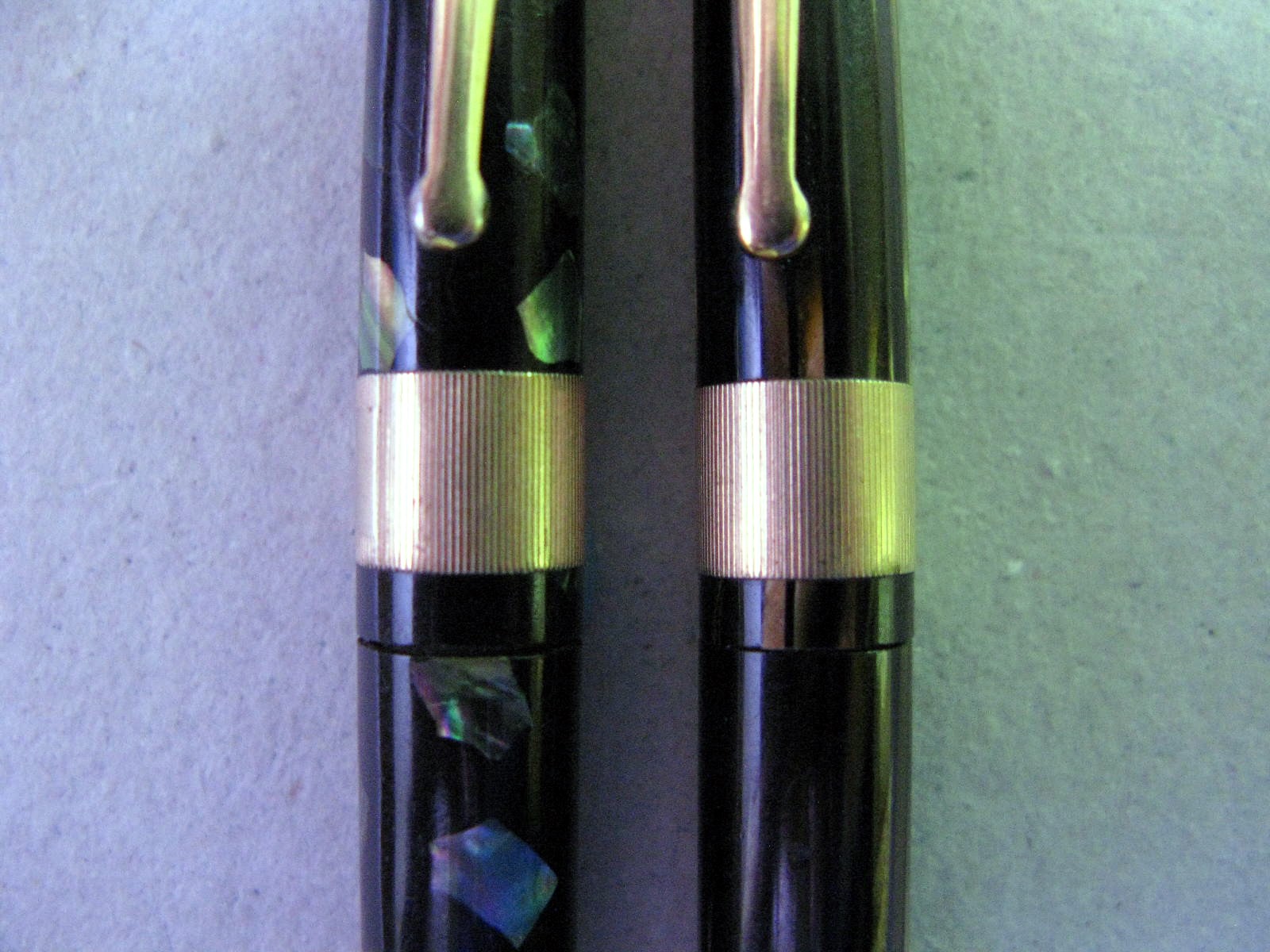
I like when I can find a pencil that's got something a bit different about it, like this ebonized pearl Sheaffer "Balance" with the larger band (center pencil, below) just waiting to have one's initials engraved on the blank space. It also fit into a missing size slot in my "floating pearl-chips" Balances. I tried with lighting to show you how these chips glow like the aurora borealis.
The larger bands for engraving have a simple ribbed design except for the spot left blank. It's more uptown than stamping a personalization into the celluloid. The other one I have is also a Balance, but with golden brown striations. Since these are middle twist pencils, the band gives you a nice grip-spot when advancing the lead.
But that is not the only thing different about the "ebonized pearl" pencil--its slightly tooth-marked top is slant-cut, not pointed.
Like no other Balance I have seen so far.
Did you notice that the tops and tips of these two are solid black? They must only have made narrow strips of this pearl. What a pity, when it's so pretty!
Wednesday, August 24, 2016
Crow Pencil Box
A week after my father's funeral, I was invited to attend the estate sale of a couple I had known at my university many years previously. It was a house full of nooks and crammed with books; it had deep layers of daily living accumulated over decades. It was a collage of a marriage, and portraiture of two individuals. I roamed through the house fascinated. Inexplicably, it was just what I needed to do at that moment.
I purchased a pencil box. It was created by Ian Nicholas in decoupage.
Inside, it looked like this:
Now, after a few weeks, it looks like this:
The Waterman metal cap repeater pencil from the 1950s seemed to belong there.
It is a cap-actuated repeater of dark grey plastic and two-tone metal, with silver tip and clip.
It uses a 0.9mm lead and has a red rubber eraser under the cap.
Among the last of the USA-made Watermans.
Saturday, June 18, 2016
Monday, February 23, 2015
The Ideal Waterman for the Lodge Brothers
This green marble Waterman pencil with gold-tone trim is a nose drive model from the 1930s. The 4 & 3/4 inch pencil has 1.1 mm lead size, and a washer style ball clip with the Ideal logo on the clip as well as the Waterman name. On the cap is imprinted "Waterman's" and "United States of America," and under the cap is an eraser.
The model of this pencil is unknown, but it is linked by its logo to that Waterman stock in trade, the Ideal fountain pen. From 1884, when the first Waterman pen was produced, for the next fifty years, the Ideal fountain pen grew the Waterman company into a large and well-known commercial venture with offices in New York, Boston, and Chicago, and outlets in San Francisco, London, Montreal, and Paris. Below is the Waterman building in mid-Manhattan, Numbers 173-177 Broadway, New York.
In the 1920s the Waterman company began making pens with emblems on the caps for organizations and fraternities such as the Rotary, the Odd Fellows, the Knights of Columbus, and all branches of the Free Masons including the Blue Lodge, the Scottish Rite, the Knights Templar, and the Mystic Shrine, now known popularly as the Shriners. They also made imprints with lodge names and numbers for individual lodges: the green marble pencil is one of these.
This is the imprint of the Free and Accepted Masons' lodge called the Solon Lodge, Number 771. It was a Manhattan lodge of mostly German-American Masons with names like Meisner and Zobel dating back to the 19th century. The lodge belonged to the greater German Masonic Temple Association, and is documented in "A Standard History of Freemasonry in the State of New York." Sadly, the lodge's identity was lost when it merged with Brooklyn's Lessing Lodge # 608 in 1978, and again with the German Union Lodge #54 in 1981. But their pencil outlasted them into the 21st century. After all, it is a Waterman!
Sunday, January 11, 2015
Tucked Away from '42 to '54
I have noticed with wry interest that things from about 1945 to 1965, or in that style, are now called "mid-century," a look that has come into vogue with those born in the '80s and '90s. They are making it their own, making it fresh --- it's clever and bright. Check out this blog site for "mid-century" renovators, for example: http://retrorenovation.com/ There's a discussion of how to make a doorbell from a rotary dial phone, where to get "atomic" shower knobs, and other useful stuff.
As a mid-century person, I have a little bit of nostalgia for the period, so I have been drawn to mid-century pencils like the Sheaffer lady's pencil called the "Tuckaway." Even the term is right out of the era--remember the Hide-A-Bed and percolator? Or how about this very dubious building material, "Fibrolite?"
Recently I added a third Tuckaway to my other two, and it is the earliest yet, the clip-less model with the wide center band, circa 1942. It has the shape of the Sheaffer Balance, but in a diminutive size (4") and with a cute little snub nose. Tuckaways use the newer .09 mm lead, sometimes called thin lead. They are middle-twist operated.
All the Tuckaways I have picked up are personalized with the name of the owner, leading one to suspect that this was either something women really liked, or that it was offered free with the purchase of the pencil--maybe both!
When Sheaffer added a clip to the Tuckaway, it also was diminutive and snub-nosed.
The grey striated ones are made of celluloid, while the burgundy is made of the new post-war plastic. It has Sheaffer's "lifetime warranty" white dot.
They all have handy grip for your fingers, but the later plastic pencil (bottom) had a new smaller point. With its two-tone trim, it was the "Sentinel" model, while the striped version with the narrow band is the "Lady." There is also a "Triumph Crest" model with a gold cap. I'll be keeping my eye open for one. Maybe look for a mid-century desk doo-dad, too!
Wednesday, November 12, 2014
A Couple of Couples
Over time, they say, married couples begin to look like each other, but these couples looked similar from the start. They are both a set of lady and gentleman's pencils from Waterman, from the mid-1930s and early 1940s.
Above are pencils in the 1930s "Thorobred" line in green & bronze agate. The gent's pencil has silver trim, while the lady's has gold. The lady's pencil has a brown celluloid tip, while the gent's has a black one. Both the pencils above are imprinted on the removable cap, which contains an eraser: "Waterman's /Reg. US Pat. Off. /Made in U.S.A." They use 1.1 mm lead and are characterized by a totally flat top. They are 5 and 4 & 1/2 inches respectively.
Sad to say, the lady's pencil has lost its clip, which fitted into the top like the Lady Patricia's clip (shown top-most, above). The Lady Thorobred pencil has a narrower band than the Lady Patricia, and a stubbier tip, but longer point.
In the 1940s, Waterman's continued to cater for both men and women with their mid-range "Commando." Here is a man's in black and a woman's in striated gold, both with gold-tone trim. While they look like repeaters, they are actually nose drive pencils, measuring 4 & 1/2 and 5 inches.
The clips fasten onto the flat tops, and have an aeronautical feel to the design. Only the clip carries the Waterman name. Although it was available, Waterman's had not yet moved to the thinner 0.9 mm lead for these pencils.
Two Waterman couples, enough for a table of bridge. Who's keeping score?
Later, I was able to find this Thorobred lady's pencil with clip intact; here it is:
See my blog about Waterman's products during the second world war: WWII and Waterman's
Subscribe to:
Posts (Atom)