Saturday, September 23, 2017

Diamond Point's Graceful Decline

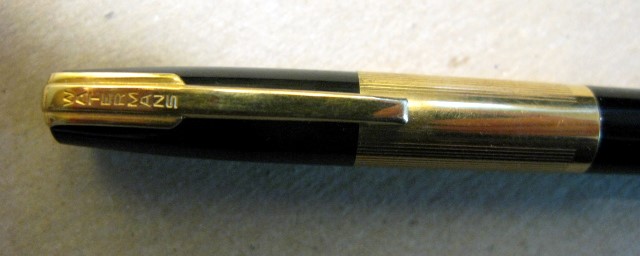
This post-Depression pencil, from the Diamond Point Pen Company, New York City, is an example from a company in decline, yet still producing something usable and reasonably attractive. Before the Great Depression, Diamond Point's nose-drive pencils were well-built and colorful, and they also made attractive middle-twist-operated pencils in nice materials.  This particular pencil is still of reasonable quality, enough so that L. Norris Post had it personalized with his signature incised on the barrel.  It is a warm, tobacco-colored marble with gold trim and a black bullseye jewel on top.  The band has two black stripes and two rows of engraved dots.  It has typical nose-drive grip on the tip of the pencil.  The mechanism is still working well.


The clip has a vertical "DIAMOND" inscription and also "PATD" inscribed along the top arch of the clip, in tiny letters.  It seems more of a deco-style clip, than a WWII style.


The top screws off to provide access to an eraser.  This is an unusual feature for a nosedrive pencil. Spare leads could be stored in the barrel.  This one still had two leads, 0.9 mm, dating the lead size to after 1938.


This is the first Diamond Point I have come across.  All-told, I could have done worse;  for a nose-drive pencil, it's several notches above average.  L. Norris, wherever you are, I'll be happy to use your Diamond Point.

Tuesday, August 15, 2017

Mastercraft During the War

The Moore Mastercraft pencil came along in 1938, just a year before the start of WWII.  It was known for its pretty, striated celluloid and what you might call "patterned marble" in colors you wouldn't be embarrassed to use at your office or jobsite.  They had nice bands and clips.  Some had two kinds of celluloid with two bands.  This is my lady's size Mastercraft.


I wrote about it here:  Moore Mastercraft

During the war in the early and mid-1940s, the Mastercraft pencil was still being produced.  Its celluloid was still very nice, with marble, patterned marble, solid colors, and the striated pattern. However, the bands and clips were simpler and more inclined to show wear, and the rivet holding the clip was smooth rather than tooled.  Here is a war-time Mastercraft.


As before, the clip's "Moore" with interlocking Os is the only marking. The standard size was like this one, 4 & 7/8 inches, with 0.9 mm lead, and middle twist mechanism.  The decoration on the clip is a precursor to the next Moore design, the Fingertip.


Sunday, June 18, 2017

WW II and the Waterman 100 Year

In 1936 the Du Pont chemical company introduced their new product, a plastic made of resin and acrylic, called Lucite.  One of the most exciting things about Lucite was that it could be clear and transparent, tinted and transparent, or opaque.  It could be made in vibrant colors.  Because it could be carved and could encompass small items like rhinestones, it was used for jewelry and ornaments, like this carved bar pin and flowered bangle.


Lucite buttons

Introduced for Christmas of 1939, Waterman pens and pencils were also made of the new Lucite.  To mark their departure from the old celluloid lines, Waterman's also boasted that the new pens would last a century!  They were called 100 Year pens (and pencils), "a Sensational New Pen. . . made of one of the most amazing materials ever to come out of a test tube."  They were offered in transparent red, green, blue, and opaque black.  Pens cost $8.50, or a pen & pencil set was $12.25.

In September of 1939 war began in Europe, and by early December of 1941, the US was also at war.
For Christmas of 1941, Waterman's returned their pen and pencil material to celluloid, allowing the acrylic blend, Lucite, to be used for airplane windshields, bomber noses, and periscopes for submarines. New colors were offered, maroon and amber, as well as blue, green, and black. Unfortunately, the wartime celluloid was not as sturdily made, and many celluloid pens and pencils sustained damage from UV light and moisture, two things which can deteriorate celluloid.

The 1939 version of the Waterman 100 Year had a ribbed case. This cap had the so-called "amber end," which was transparent. It served no purpose, except to show off the new material, Lucite.  It looks like a repeater, but it is a twist pencil.  The clip is unmarked; the imprint is on the back:  Waterman's, United States of America.  It had a wide enough band to be personalized with engraved name or initials.  It is smaller (4 & 1/2 inches) than the later 100 Year (5 & 1/8"), and uses the thinner lead introduced in 1938.


One innovation the 100 Year instruments displayed was a "modern" clip design in which the clip began right at the top of the cap.  Below is the smooth-case 100 Year, now with the brand name on the clip.  This is the war-time model of 1941.


This style clip was already in use for Waterman's Lady Patricia and the Lady Thorobred pencils.


Interestingly, the clip suited military regulations for pens or pencils carried in uniform pockets:  they must never show below the pocket flap or cause the flap to bulge upward.  They must be perfectly concealed.  The less expensive line of Watermans, the Commando, available at the same time as the 100 Year, also used this clip, which came to be known as the "military clip."


Waterman Wartime 100 Year pencils
Waterman Commando pencils


Sunday, May 14, 2017

How Super!

William DeWitt and David LaFrance began a pen & pencil company in the 2nd half of 1918, first making fountain pens and then adding mechanical pencils by or before 1920 at 54 Washburn, Cambridge, just across the Charles River from Boston.  It was an excellent location given the numerous seats of higher education in Cambridge, including Harvard and Radcliffe.  The inventors applied for two pencil patents in 1919, so they had to have made some pencils, at least as prototypes, in that year.  Their patents were granted in 1920 and 1922.  Before that the pair engaged the Samuel Ward Manufacturing Company of Boston to make their products, some of which were marked SaWaCo.

Here is one of the DeWitt-La France ring-tops, a 4 inch, rear drive, twist pencil with a pleasant design, and the imprint in capital letters, SUPERITE, NICKEL, PAT.  Their longer pencils with a clip were similar, and marked SUPERITE, Pat Pend. or Pat. The nickel alloy is still bright and the pencil is still working after 97 years.


This Superite has a smooth crown-top, but some have a floral design around the crown.


Some of the Superite barrels are plain, some have engraved designs.  The company also made a tiny version of the ring-top called the Superite, Jr., and a few pencils by DeWitt-LaFrance can be found marked DeLaCo.

Unfortunately for the young company, giant Wahl-Eversharp sued DeWitt-LaFrance in the spring of 1922 for imitating the lettering on their Eversharp pencils (which Wahl had “borrowed” themselves from the Winchester Repeating Arms Company) and for copying other unspecified features of their product, with the objectives of obtaining an injunction against the manufacture of the Superite pencils and gleaning damages from DeWitt-La France.  The crowns of all these metal pencils derive from classical architecture column shapes; it's hard to image one company trying to put a claim on them. The inner workings of the pencil were patented by the two inventors. That leaves the engraved designs and the clips as possible contested features.  The Wahl company got their pencil workings from inventor, Charles Keeran, who began making them in 1913, via the George W. Heath Company, and their original fountain pen doings from the Boston Fountain Pen Company in 1918.


Fonts are many and varied in the extreme; while both companies used a serif italic font, it seems to me that the DeWitt-LaFrance font used for the Superite is rather like Century Old Style, while the Eversharp has much more emphatic, slanted serifs.  You have to wonder why it was not Winchester suing Wahl-Eversharp.


The two inventors, DeWitt and La France, received a contract to make pencils for Rexall Drug Stores at about the same time, and did so under the Signet name, but eventually they appear to have sold out to Carter’s Ink of Boston in about 1925.  They became interested in radios, and called their new product the “Superadio.”  They are now prized by collectors of vintage tube radios.


Recently, I added a 5 & 3/8 inch gold-filled clip-pencil to my collection.  It is inscribed 1/9 gold filled, Pat, and PATD on the clip, dating it to after 1922. The personalization reads "1873-1923," dating the pencil to 1923.  You have to wonder what 50th anniversary was being commemorated.  Excelsior Paper Company, Holyoke, MA, perhaps.  Hartshorn and Wilcox, the architectual firm?  Or how about American-La France, the maker of fire engines?  They all were founded in 1873.  Or a golden wedding anniversary gift. . . could be that, I suppose.


Super products from a couple of interesting inventors.
For more about the complex history of the metal pencil see Jon Veeley's blog series:
wahl-sheaffer-and-race-for-boston


Sunday, April 23, 2017

Pencil Sketch--Welsh Cottage


Welsh stone cottage with attached byre

Dollarpoint's Little Lady


The Los Angeles Dollarpoint company's mini-ringtop for ladies in their Artpoint model measures just 4 inches.  Otherwise it is very similar to the full-sized Artpoint pencils with clips; both were made made in the early 1920s.   The greeny-bronze patina shows the pencil is brass.

A lot of design in a small package.


To see my post about the larger clip-version of the Artpoint (shown above), click the link below:
Inspired by Women


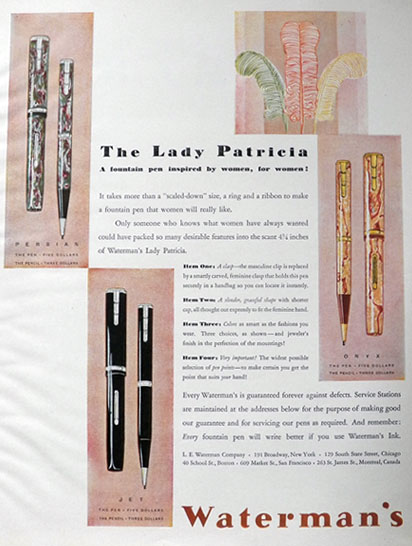
If you had any doubt that the petite Lady Patricia pencil (and pen, of course) was meant for women, you have only to see this ad:  "The Lady Patricia-- A fountain pen inspired by women, for women.
It takes more than a 'scaled-down' size, a ring and a ribbon to make a fountain pen that women really like."  In the ad you can see the pen and pencil sets in the Persian, Jet, and Onyx colors.  

Recently I added the Moss Agate color pencil to my group of Lady Ps.  The marble is green pearl and a glittery bronze with black veins and solid black point section.  Its clip, tip, and band are gold-toned.


The imprint is on the back of the cap, which screws off to allow access to the eraser.  It uses 1.1 mm lead, and as the ad mentions, is 4 & 1/4 inches.  According to the ad, every Waterman's is "guaranteed forever," but if they did go wrong, "service stations" were maintained for repair.

The pen, photo courtesy of the Fountain Pen Network, is below.


Click this link to see three other Lady Patricia pencils:


Sunday, April 9, 2017

Sheaffer Skripsert Pencil

Yet another family Sheaffer pencil came to light recently, my dad's black and silver Skripsert which accompanied the Skripsert pen.  Skrip was the brand name of Sheaffer ink, coyly called "writing fluid" by Sheaffer.  If this bottle doesn't look familiar, you're probably too young to remember fountain pens, too.


The bottle had a shallow well in the glass at the top for the easier filling of your pen.


Ink came in different colors, and in permanent or (allegedly) washable.

The Skripsert pen was, I believe, Sheaffer's first pen filled by an ink cartridge.  Oh, joy!  No open bottle of ink!  Nothing to spill, nothing to fill.  You just take apart the pen, slide the empty ink cartridge out, and pop a new one in, with no ink anywhere near your hands or furniture.  This is how virtually all modern fountain pens and technical pens are filled.  


Skripsert was the name Sheaffer gave the pen that could have the Skrip inSerted into the pen via a cartridge.  It was mid-century advertising ploy, cutesie brand names made of combined words.  

Here is the pen.


And here is the matching pencil.


It's a smaller twist pencil at 4 & 5/8 inches.  It uses the thinner 0.9 mm lead.
You can't quite see the blue eraser -- it's worn down to a nub.

For more of my family Sheaffers: 

Lady Patricia Remodeled

The Depression-era petite 4 & 1/4 inch pencil called the Lady Patricia (companion to the pen of the same name) was re-designed when Waterman's created their new "Ink-Vue" pen, with a transparent barrel section, so you could view the ink, of course, in order to know when you were running low.


The Lady Patricia pencil acquired a new clip and center band, and was even smaller than before, at 4 & 1/8 inches.  Two colors of marble were available at first, "Sunset," a red, and "Mist," a green-grey, with a color-matched section of Bakelite in the point.  Also, "Black Lace" was offered--a solid black. Here is my newly acquired "Mist" version.


The clip has a diamond pattern, as does the center band.  The imprint is on the back of the cap, which screws off to reveal the eraser.


This is the Sunset color Lady Patricia Ink Vue pen.
And here are my other Lady Patricia pencils, in the onyx (right), and jet colors.


At Vintage Pens.com is a good description and history of the Ink-Vue pens and pencils:  Waterman Ink-Vue