Sunday, April 23, 2017

Pencil Sketch--Welsh Cottage


Welsh stone cottage with attached byre

Dollarpoint's Little Lady


The Los Angeles Dollarpoint company's mini-ringtop for ladies in their Artpoint model measures just 4 inches.  Otherwise it is very similar to the full-sized Artpoint pencils with clips; both were made made in the early 1920s.   The greeny-bronze patina shows the pencil is brass.

A lot of design in a small package.


To see my post about the larger clip-version of the Artpoint (shown above), click the link below:

Inspired by Women


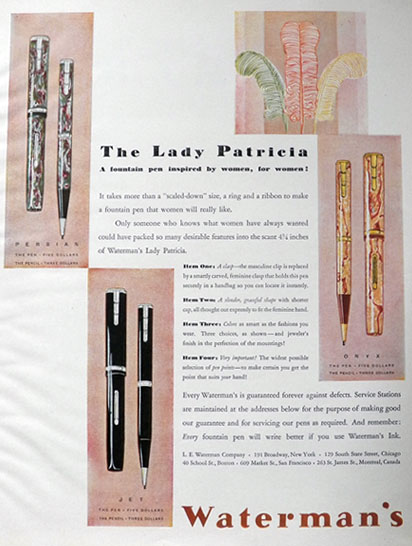
If you had any doubt that the petite Lady Patricia pencil (and pen, of course) was meant for women, you have only to see this ad:  "The Lady Patricia-- A fountain pen inspired by women, for women.
It takes more than a 'scaled-down' size, a ring and a ribbon to make a fountain pen that women really like."  In the ad you can see the pen and pencil sets in the Persian, Jet, and Onyx colors.  

Recently I added the Moss Agate color pencil to my group of Lady Ps.  The marble is green pearl and a glittery bronze with black veins and solid black point section.  Its clip, tip, and band are gold-toned.


The imprint is on the back of the cap, which screws off to allow access to the eraser.  It uses 1.1 mm lead, and as the ad mentions, is 4 & 1/4 inches.  According to the ad, every Waterman's is "guaranteed forever," but if they did go wrong, "service stations" were maintained for repair.

The pen, photo courtesy of the Fountain Pen Network, is below.


Click this link to see three other Lady Patricia pencils:


Sunday, April 9, 2017

Sheaffer Skripsert Pencil

Yet another family Sheaffer pencil came to light recently, my dad's black and silver Skripsert which accompanied the Skripsert pen.  Skrip was the brand name of Sheaffer ink, coyly called "writing fluid" by Sheaffer.  If this bottle doesn't look familiar, you're probably too young to remember fountain pens, too.


The bottle had a shallow well in the glass at the top for the easier filling of your pen.


Ink came in different colors, and in permanent or (allegedly) washable.

The Skripsert pen was, I believe, Sheaffer's first pen filled by an ink cartridge.  Oh, joy!  No open bottle of ink!  Nothing to spill, nothing to fill.  You just take apart the pen, slide the empty ink cartridge out, and pop a new one in, with no ink anywhere near your hands or furniture.  This is how virtually all modern fountain pens and technical pens are filled.  


Skripsert was the name Sheaffer gave the pen that could have the Skrip inSerted into the pen via a cartridge.  It was mid-century advertising ploy, cutesie brand names made of combined words.  

Here is the pen.


And here is the matching pencil.


It's a smaller twist pencil at 4 & 5/8 inches.  It uses the thinner 0.9 mm lead.
You can't quite see the blue eraser -- it's worn down to a nub.

For more of my family Sheaffers: 

Lady Patricia Remodeled

The Depression-era petite 4 & 1/4 inch pencil called the Lady Patricia (companion to the pen of the same name) was re-designed when Waterman's created their new "Ink-Vue" pen, with a transparent barrel section, so you could view the ink, of course, in order to know when you were running low.


The Lady Patricia pencil acquired a new clip and center band, and was even smaller than before, at 4 & 1/8 inches.  Two colors of marble were available at first, "Sunset," a red, and "Mist," a green-grey, with a color-matched section of Bakelite in the point.  Also, "Black Lace" was offered--a solid black. Here is my newly acquired "Mist" version.


The clip has a diamond pattern, as does the center band.  The imprint is on the back of the cap, which screws off to reveal the eraser.


This is the Sunset color Lady Patricia Ink Vue pen.
And here are my other Lady Patricia pencils, in the onyx (right), and jet colors.


At Vintage Pens.com is a good description and history of the Ink-Vue pens and pencils:  Waterman Ink-Vue

Thursday, January 26, 2017

Eclipsed by Hard Use and Old Age

This derelict Eclipse has seen better days, but I rescued it anyway.  It was somebody's favorite pencil in about 1920.  The gold plating has been worn off almost entirely, and the once-crisp check design is nearly flat and smooth along the pencil's lower half.  It still propels its .046 inch lead with a rear drive mechanism.  It is 5 & 1/4 inches, with a place for an eraser under the cap, but the eraser is long gone. Like other rear drive pencils, it can hold a long lead.

This is an all metal Eclipse before the advent of the 2-piece patented clip of 1923, which is found on my first Eclipse, here:  Pleased to Meet You


In 1962 the Canadian branch of the Eclipse Pen Company (started in 1925) bought out the American branch, its operations, and patents.  After decades in New York,  Eclipse moved entirely to Canada.  A decision for which I have no small amount of sympathy.

Tuesday, January 17, 2017

Dur-O-Lite Dream


Generally, I avoid advertising pencils, they're just not my cup of tea.  But never say never!  This Dur-O-Lite from the post- WWII era caught my eye.  It didn't hurt that it was red! Its advertising slogan is not for a product or a company, but for a concept--electric heat.


It is a thought I have been pondering as a homeowner, when considering furnace and water-heater replacements, especially with the creation of a "solar garden" recently by our city utility company. Citizens funded the endeavor by buying shares, and are receiving dividends in the form of a rebate on their electric bill.  For me, that was a no-brainer decision.  Solar and wind power are the future.  For some nations, clean energy is the present, as in Germany, Denmark, Sweden, and Norway.  When I lived in Europe in the nineties, these countries were already focused on changing to clean energy, and they were not daunted by lack of space or the expense of the technology.  Solar panels have now been developed that multi-task as roofing shingles and highway pavement, using no additional space at all. Technology has advanced, bringing the costs down and making significant improvements in efficiency.

One company, Land Art Generator Initiative uses art to promote clean energy. In 2009, they calculated that an area slightly larger than California covered with solar panels would power the entire world with solar energy. And just to power the United States? A few counties in Texas.


When this Dur-O-Lite hard plastic pencil was imprinted with its slogan, electric heat was powered by coal and other fossil fuels, but now the dream of every home having electric heat using clean, renewable energy is entirely possible, and urgently needed. Someday, the dream expressed by this humble red nose drive pencil might be reality. I hope it is someday soon.


To see a short video clip of my town's solar array, click here:
Prairie Lakes Solar


Thursday, January 12, 2017

Baby Blue

This blue striated celluloid mini-size repeater with silver trim is my latest Esterbrook, from a New Jersey pen/pencil company I have just gotten to know, but now admire.  How mini?  4 & 3/8 inches.


 The model is called the Dollar, because, of course, the pens cost a dollar, so the pencil probably cost the same or less.  It was a model made from 1934 until 1942.  Dollar models can be identified by the clips with the oval cut-outs.  From 1934 to 1937 the clip had a taper at the top, and from 1938 to 1942 the tops of the clips were the widest part, like this little pencil's.


Since 1938 was the date the new wide-top clip was introduced, and in that same year "thin lead" (0.9 mm) became available, perhaps both changes were made to the Dollar pencil at the same time.  The flat top of the clip is engraved with Esterbrook in script.


The small size pen and pencil were known as the demi model H.  On this H pencil, you can see the imprint has a fancy script H.  The imprint says, " R Esterbrook H, PAT. MADE IN USA."


Dollar pens and their matching pencils had two other models:  the slimmer A, and the regular size, B.
But you can hardly beat the baby blue model.

Here is my first post about Esterbrook:  New To Me
To learn more about Esterbrook pens:  Esterbrook.net


Thursday, December 22, 2016

Two Points of View. . . uh. . .Lead

Recently I ran across a nice Autopoint "Twinpoint" pencil in its original box with leaflet in never-even-used condition.  It got me to wondering about double-ended pencils, so I looked for more of them and only found one other company who made a double-point mechanical pencil. It is on the other end of the alphabet from Autopoint:  the Zaner-Bloser company of Columbus, Ohio.  There are quite a few pen/pencil double-ended writing tools, but only these two pencils, as far as I know.
The Autopoint is the adult version, while the Zaner-Bloser is more the kids' version.  They both have a red and a blue lead.  Naturally, they are nose-drive pencils.

Zaner-Bloser pencil

Autopoint pencil
The Autopoint company has a long and complex history, having been owned by Bakelite, Union Carbide, Cory, the Hershey Chocolate company, Gillette, and Papermate. At the time this double-ended pencil was made, Autopoint was a division of the Cory Corporation.  To me, Cory is best known for its glass coffee maker, shown here in an ad from the Ladies Home Journal of 1948.  Its founder invented the glass filter used in the all-glass pot--kind of reminds me of something in chemistry lab!


1801 Foster Avenue, the Autopoint factory in Chicago, is now a brewery with taproom.  Autopoint is now an independently owned company located in Janesville, Wisconsin, from whom you can buy lead in several colors and sizes, and other Autopoint creations, including the Twinpoint and two other styles of mechanical pencils.  Here is a link to the current Autopoint Catalog 

Leaflet in the original box


This is the riveted clip used by Autopoint for decades.  
Now the Twinpoint pencil has an "accommodation clip" which can be reversed or even removed.


Twinpoint pencil's original box


Isn't that a stylish logo?
And here are the two points.


Friday, December 16, 2016

Pleased to Meet You


It's always a pleasure to receive an introduction to a new-to-me brand.  This time it is Marx Finstone's New York City pen and pencil company that created this 5 & 1/4 inch Eclipse.  My new pal is a 1930s model with the patented 2-piece clip, which gives the patent date, 9-18-23, shows the Eclipse logo in a circle, and also says Eclipse in caps.


It is a flat-top with a black cap and gold trim.


The cap has an eraser under it.  It is a rear-drive pencil with the larger 1.1 mm lead,
and yellow-green and black celluloid marble case.
If the top were pointed, you'd think of a ball clip Sheaffer Balance; 
they are similar in substance and style.


It's good to be back in New York!